
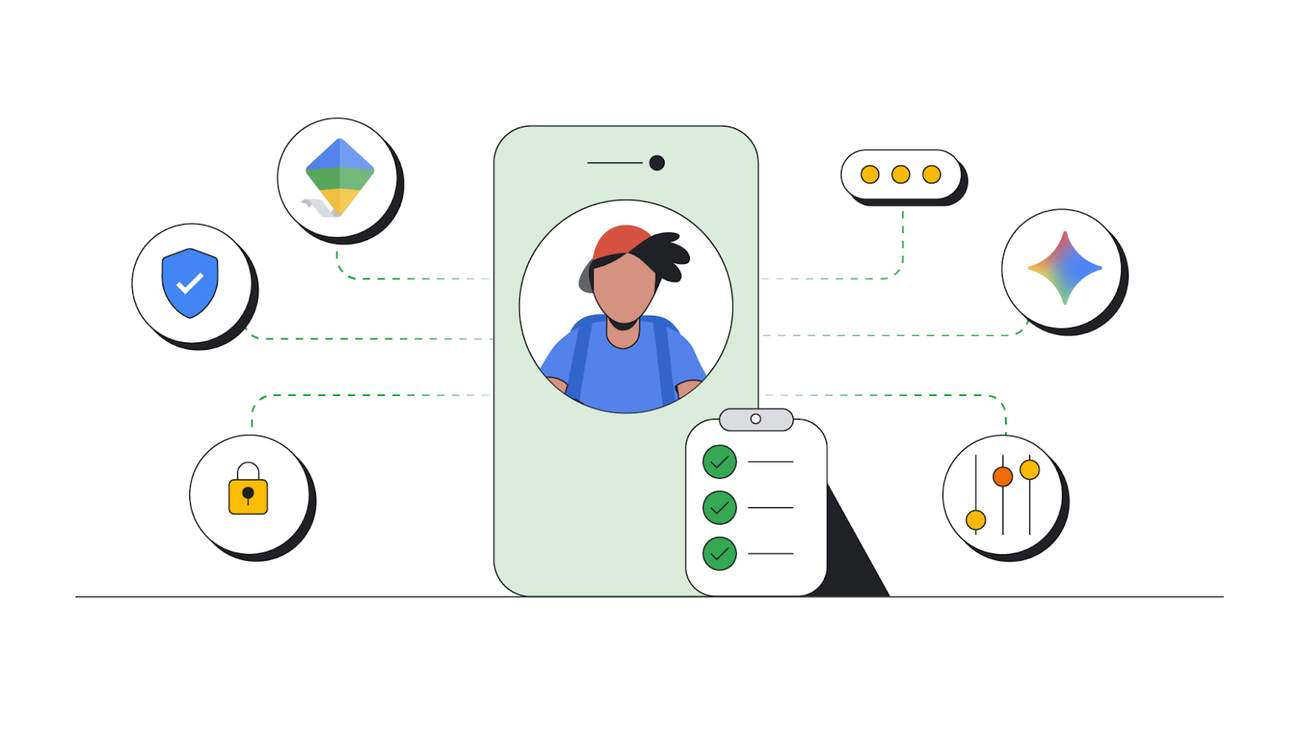
For the first time, people are reporting that their primary motivation for using AI is not entertainment, but learning. Teenagers in particular are excited about artificial intelligence and digital tools to support their learning and creativity, but don’t want to go it alone – they want guidance, balance and support to help them safely navigate the new learning frontier.
To support Safer Internet Day, we’re highlighting five ways students, parents and educators can work together to stay focused on safe and effective learning.
Support learning with smarter online/offline boundaries
Knowing when to step away can be just as important as knowing when to dive in. Protections like Protected Search are enabled by default for kids, and Family Link can support smarter limits – including screen time management, app approvals, content filters, privacy settings and more. “School Time” supports distraction-free learning by limiting the device’s functionality to school and homework.
Fostering critical thinking in the age of AI
From history to computer science, anyone delving into anything needs to know the “why” as easily as the “what.” Using guided learning in Gemini, students are guided to approach complex problems step by step, encouraging critical thinking about shortcuts and answers. Nearly three-quarters of people now use AI in education, and a majority of teachers believe AI will improve student outcomes.
Help teenagers view AI content and evaluate information online
As sophisticated AI tools become more common, it is more important than ever to understand the origins and context of media we interact with. Best practices like the “SIFT” method in the Super Searchers training program—Stop, Investigate Source, Find Better Coverage, and Track Claims—help students critically evaluate online information. “About this image” in Search provides useful context about the images you encounter online, and SynthID watermarks identify when an image, sound or video was created using Google’s AI.
Involve parents and guardians
Parents can stay involved by understanding the platforms their kids use and working together to set family guidelines, whether it’s learning, socializing, or more. YouTube’s Supervised Accounts for Teens are designed to respect a teen’s growing autonomy while still ensuring parents are in the loop, providing shared insight into their teen’s channel activity, including the number of uploads, subscriptions, and comments. This year, we also introduced a set of quality principles that will make it easier for teens to find higher quality, enriching, age-appropriate content on YouTube.
Improve digital citizenship
The online world is a global community, and good citizenship extends beyond the classroom. With cyberbullying a growing concern, teaching the basics of digital citizenship and online safety is more important than ever. Be Internet Awesome provides resources for educators and families to empower young people to be smart, aware, strong, kind and brave online.
Access – with appropriate guardrails – can open up new avenues of learning, creativity and opportunity for young people. For practical tools and resources to help families explore, learn and stay protected in an evolving online landscape, see the Family Guide to Online Safety in 2026.
Google supports Safer Internet Day (SID), an initiative led by the European Commission that brings together stakeholders worldwide to promote a safer and more positive internet. SID is organized as part of the European Commission Better internet for children initiative.