
When I talk to Blake Resnick, he’s walking around his drone startup’s newest office space in Seattle—a cavernous 50,000-square-foot facility that, Resnick estimates, won’t be fully set up until later this year—potentially November. Still, the large (and for now largely empty) building offers the promise of a fast-growing company intent on conquering its particular industry.
The industry in question is public safety, and the startup is Brinc, which sells drones to police and government agencies across the United States. The company wants to be the “DJI of the West,” as Resnick has put it — a nod to the Chinese drone maker and a signal that Resnick wants Brinc to become just as synonymous with the technology it sells.
A former Thiel Fellow — a prestigious program that funds young entrepreneurs to skip or delay college — Resnick founded Brinc in 2017 and soon after garnered interest from then-OpenAI founder Sam Altman, who ultimately served as one of Brinc’s first seed investors. Since then, Brinc has benefited from a number of financing rounds and at its last value was valued at almost half a billion dollars, says Resnick.
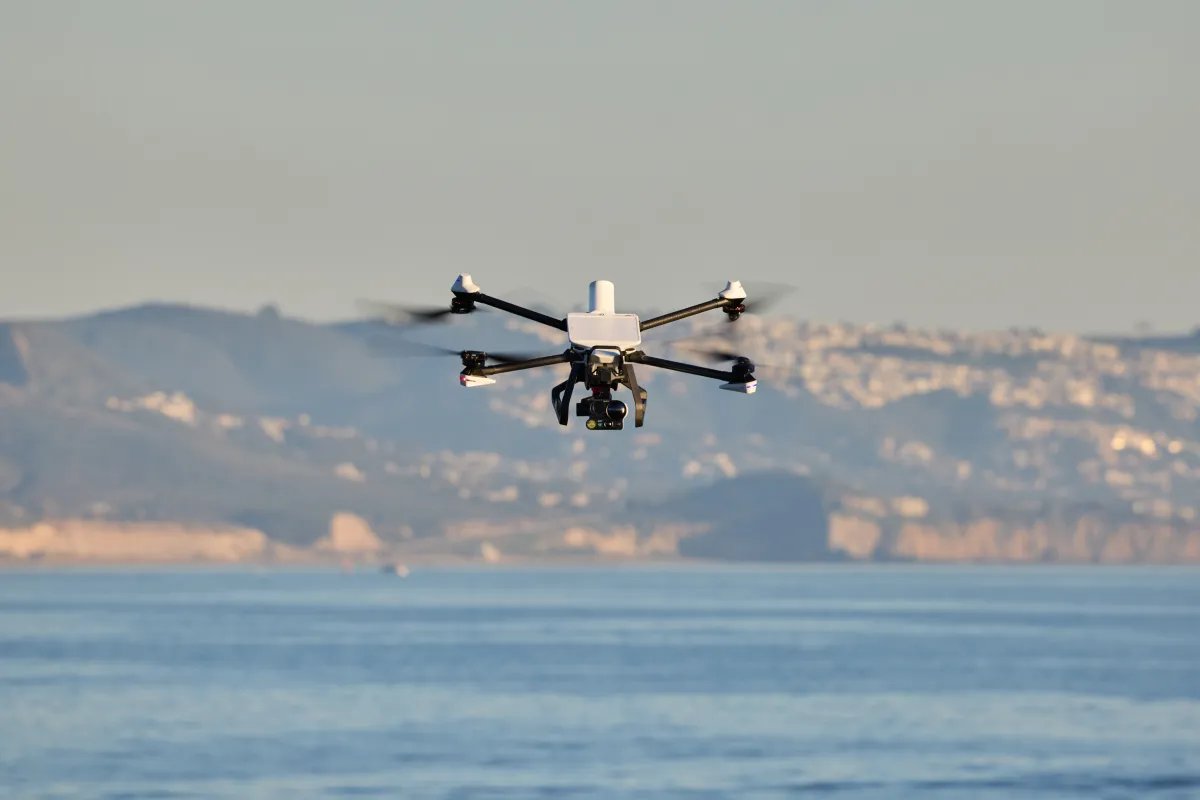
Brinc launched its newest product on Tuesday, a new public safety drone called the Guardian, which Resnick says is “the closest thing to a police helicopter replacement that the drone industry has ever produced.” Brinc claims it is the world’s “most capable 9-11 response drone” ever.
The Guardian certainly comes with some formidable specs and capabilities. The drone can fly at speeds of up to 60 mph and can sustain a 62-minute flight time, its creator says. It is also equipped with thermal imaging cameras as well as two additional 4K cameras – all of which have zoom capabilities. “Even from a considerable height, a police department could read, like license plate details,” Resnick says. In addition, there is a spotlight and a speaker louder than a police siren.
The drone’s landing station (which Brinc calls a “charging nest”) offers fully automated battery replacement and can be loaded with critical safety supplies like defibrillators, flotation devices and Narcan, all without human intervention.
The Guardian also comes with a Starlink panel embedded directly into its body, making it – according to Brinc – the first public safety drone with such a capability. Starlink, SpaceX’s satellite internet service, provides drone connectivity anywhere in the world. “Starlink has never been built into a commercially produced quadcopter before, so [it] gives this airframe unlimited range anywhere in the world,” says Resnick.
Techcrunch event
San Francisco, CA
|
13.-15. October 2026
Resnick clearly sees public safety as a big opportunity. “There are about 20,000 police departments in America, 30,000 fire departments, 80,000 police and fire stations — and we think the top half of that market in the future will have a 911 response drone in a recharging nest on the roof,” he said. “It certainly looks like we’re looking at a $6 billion to $8 billion market opportunity,” he said, assessing markets in both the U.S. and other countries.
On that front, Brinc recently partnered with the National League of Cities on a program to scale “drone as first responder” programs in communities across the country—a move that’s sure to help foster relationships between the startup and communities that could eventually become customers.
In addition, Resnick feels that recent geopolitical developments have worked in his company’s favor. Until recently, DJI had an unofficial monopoly on the global drone market – including in the US, where security agencies have long relied on the Chinese company’s products. However, the Trump administration recently banned foreign-made drone models from entering the country, opening up a huge potential market.
“There’s a huge need for a DJI from the West or a leading drone manufacturer for the free world, and ultimately that’s what we want to be,” says Resnick.