
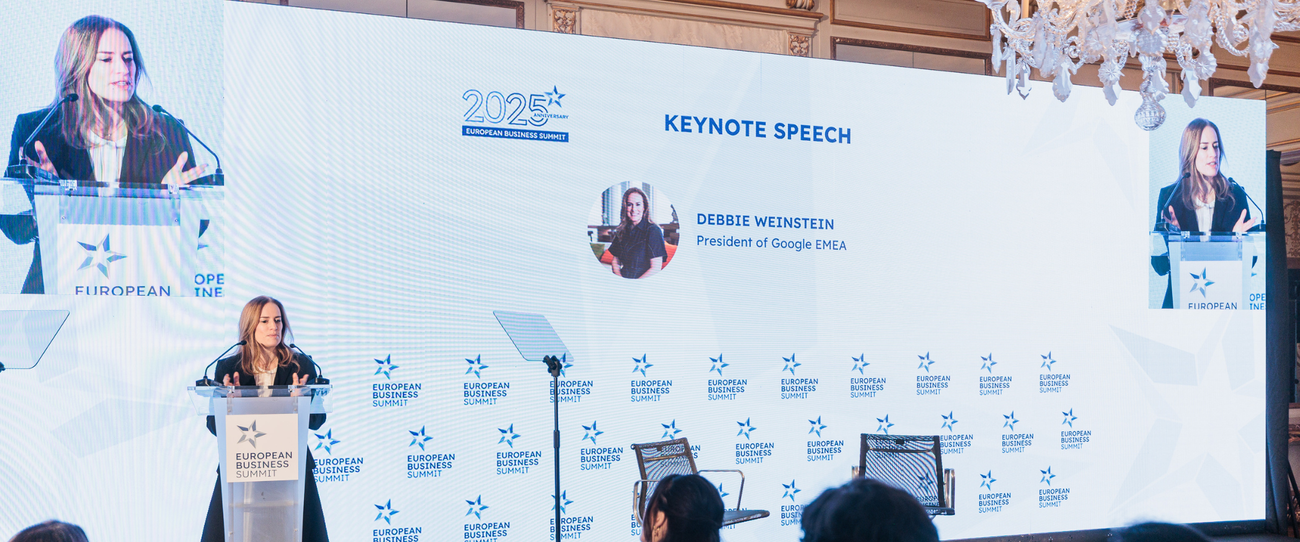
Editor’s note: This week, Debbie Weinstein gave her first public speech at the European Business Summit in Brussels, which brought together European business leaders and policy makers. These remarks have been adapted from her speech and edited for brevity.
A new generation of European companies
One of my favorite things about my role is that I get to work with leaders of companies of all sizes to make AI useful for them and drive their growth.
Earlier in my career I was the founder of a small children’s food company. I know the challenges small businesses face.
Looking around Europe today, I see incredible opportunities for a new generation of visionary founders building the businesses to drive our region’s future economy.
The opportunity is now – with the shift to AI, a technology that gives businesses the most powerful toolbox they’ve ever had.
And the opportunity is here – because the talent in Europe today is as bright as anywhere else in the world, and it is as promising as I can remember.
Startups like Idoven, a Spanish startup on a mission to help doctors detect heart disease earlier – are outstanding examples of Europe’s potential.
And at Google, we are long-term believers and investors in that potential. We chose to make our home in Europe in 2001 because we wanted to help give hundreds of millions of people access to information, technology and opportunity.
Our relationship with Europe is a partnership – we live here, we build here, we are part of the communities we serve across the continent.
We have over 40 Google offices and 31,000 colleagues based in Europe. We are investing in major infrastructure – which supports connectivity across the continent – including a €5.5 billion investment in Germany last week. We also chose to base our security operations centers in Munich, Dublin and Malaga because of Europe’s deep commitment to privacy and security.
And of course we have the Nobel Prize winning team at Google DeepMind driving scientific breakthrough after scientific breakthrough, with almost a million users of AlphaFold across EMEA alone.
None of this would be possible without European talent and leadership, and we are excited about the transformative opportunity here and now with AI.
At the same time, we speak with a sense of urgency—of determination to ensure that the future is secure and the AI opportunity is not lost.
The urgency of the moment
These brilliant, visionary European founders need an environment that champions their success. And they need it soon.
Artificial intelligence creates the potential to boost the regional economy by 1.2 trillion euros within a decade. But right now Europe lags far behind other regions in realizing this potential. Only 14% of European companies currently use artificial intelligence, far below China and the US.
To put it simply: European businesses deserve the best AI tools and services – but they’re not getting them at the moment.
In my daily conversations with these companies of all sizes across Europe, I hear 3 themes over and over again. They want access to the latest technology, simpler rules to clear the way for growth and the right skills to make that growth a reality.
Access to the best and latest technology
When it comes to providing access to the latest technology, Europe all too often puts itself at a disadvantage. The latest Google AI models are 300 times more powerful than the latest technology just two years ago.
So a European company built on old technology is wading through quicksand compared to its competitors elsewhere. This applies in all sectors:
In the automotive industry, for example, the latest AI tools could mean upgrading from a basic voice assistant to a co-pilot that understands that a driver is tired before an accident happens.
In cyber security, the latest tools are essential to counter sophisticated criminals who use artificial intelligence in skillful and dangerous ways.
Without that access, Europe will fall further behind as other regions move forward.
But instead of speeding up access to the cutting edge, we see some European governments doing the opposite – taking steps to hold back the most advanced technology.
Simpler rules
European businesses – and citizens – need a simpler and clearer path to growth. But since 2019, we have seen over 100 EU regulations aimed at the digital economy.
Mario Draghi’s report made it crystal clear that this is not sustainable. And it’s not just the number of rules, it’s also abrupt political shifts.
Companies in the EU should be able to rely on a clear scheme for the responsible training of AI models based on existing regulation.
We’ve seen this with the delay of Meta’s Llama multimodal models, with the limitations of OpenAI’s Advanced Voice Mode – and with our own delays in launching AI Overviews and AI Mode, both of which were significantly slower to launch in Europe than the rest of the world.
In addition, a third of European developers at small technology companies have had to remove or downgrade features to comply.
European businesses and citizens deserve better.
To be clear, simpler rules do not mean an “anything goes” approach to regulation.
AI needs to be regulated – but it should be regulated well in a way that doesn’t penalize companies and hold back Europe’s competitiveness.
The publication of the Commission’s digital omnibus yesterday is a step in the right direction to enable European companies to compete globally.
But we would like to continue to see greater and more significant progress to harmonize redundant digital rules; provide sufficient time and clarity for more companies to prepare for compliance; and ensure that all digital regulations take into account their impact on users.
Building the right skills
Finally, seizing the AI opportunity for Europe means giving people and businesses the chance to build the right skills – and with them the confidence to be bold and take risks.
We certainly need the data scientists and engineers to build the models and integrate them into products and services.
But we also need leaders and managers who can identify AI opportunities and a workforce in any field that is AI-savvy, able to use these new tools safely and effectively.
Building that kind of workforce will take a long-term approach.
Over the past decade, Google has worked with governments to help over 15 million Europeans learn digital skills to build their business or career.
We have also worked with more than 500 startups to support their growth.
We are committed to playing our part in building skills and training approaches for the AI era.
And what we know from our experience over the past decade is that only a partnership approach can make a difference at scale.
That means the right tools and training for schools, and it means programs that support the most vulnerable — like the €15 million AI Opportunity Fund, a collaboration between Google and civil society organizations across the region.
Across Europe, the next generation of companies, founders and workers are working to seize the AI moment.
They are the next chapter in a story that Google has been proud to help write for almost a quarter of a century.
They deserve our support to access the best AI tools and services, a clearer path to growth, and the skills to build with confidence for what’s next.
In return, I have no doubt that they will play their part in helping Europe realize the €1.2 trillion AI opportunity – and lead the world on its way.
I look forward to working with all of you to build that future together.