
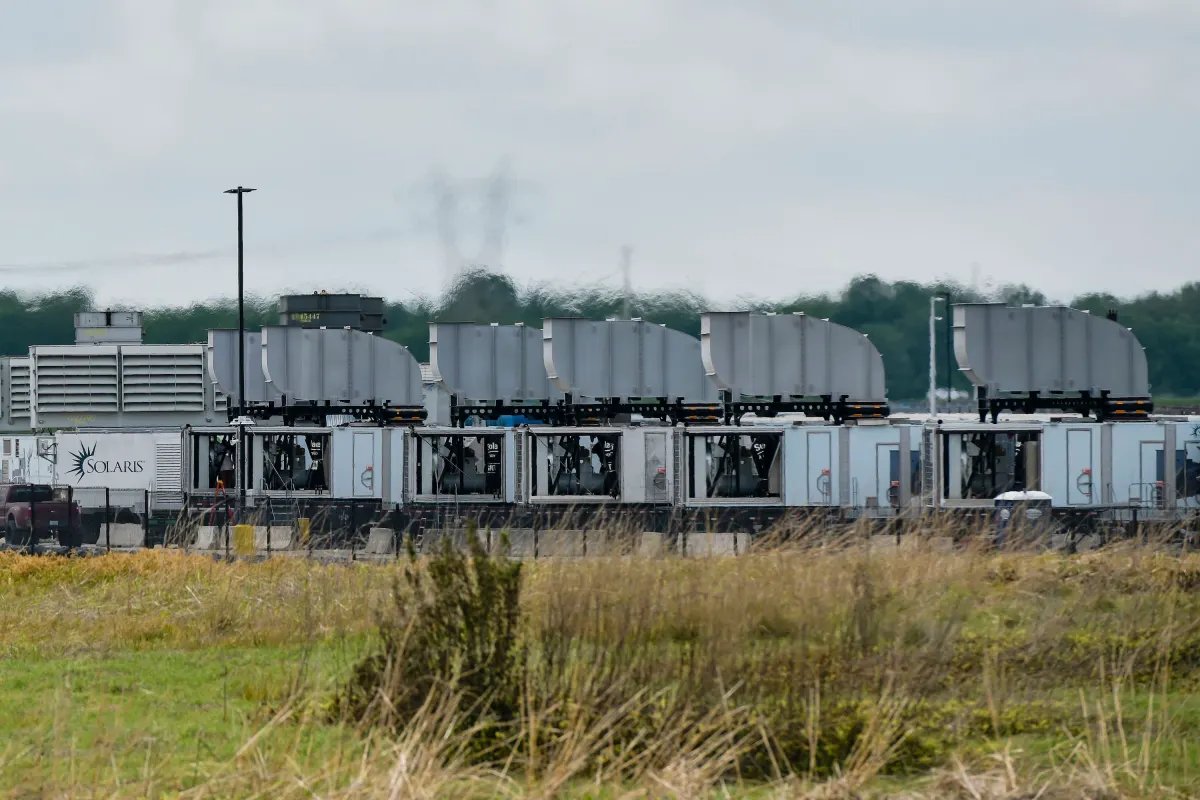
There was a time when most Americans had little or no knowledge of their local data center. Long the invisible but critical backbone of the Internet, server farms have rarely been a point of interest to people outside the tech industry, let alone an issue of particularly compelling political resonance.
Well, as of 2025, it looks like those days are officially over.
Over the past 12 months, data centers have inspired protests in dozens of states as regional activists have sought to fight America’s ever-increasing build-out of data processing. Data Center Watch, an organization that tracks anti-data center activism, writes that there are currently 142 different activist groups across 24 states organizing against data center development.
Activists have a number of concerns: the environmental and potential health impacts of these projects, the controversial ways in which AI is being used and, most importantly, the fact that so many new additions to America’s power grid could drive up local utility bills.
Such a sudden populist uprising seems a natural reaction to an industry that has grown so rapidly that it is now appearing in people’s backyards. As the artificial intelligence industry has grown to dizzying heights, so has the cloud computing business. Recent data from the US Census Bureau shows that since 2021, data center construction spending has increased by an astounding 331%. The costs of these projects amount to hundreds of billions of dollars. So many new data centers have been proposed in recent months that many experts believe a majority of them will not – and indeed could not – be built.
This build shows no signs of slowing down in the meantime. Major tech giants – including Google, Meta, Microsoft and Amazon – have all announced significant capital spending for the new year, the majority of which is likely to go towards such projects.
New AI infrastructure is being pushed not only by Silicon Valley, but by Washington, DC, where the Trump administration has made artificial intelligence a central part of its agenda. The Stargate project, announced in January, set the stage for 2025’s massive AI infrastructure by heralding a supposed “re-industrialization of the United States.”
Techcrunch event
San Francisco
|
13.-15. October 2026
In the process of scaling itself exponentially, an industry that once had little public exposure has suddenly been thrust into the spotlight—and now it’s suffering a backlash. Danny Cendejas, an activist with the nonprofit organization MediaJustice, has been personally involved in a number of actions against data centers, including a protest that took place in Memphis, Tennessee, earlier this year where locals came out to reject the expansion of Colossus, a project of Elon Musk’s startup, xAI.
Cendejas told TechCrunch that he meets new people every week who express interest in organizing against a data center in their community. “I don’t think this is going to stop anytime soon,” he said. “I think it will continue to build and we will see more wins – more projects will be stopped.”
Evidence to support Cendejas’ assessment is everywhere you look. Across the country, communities have reacted to recently announced server farms in much the same way the average person might react to the presence of a highly contagious plague. In Michigan, for example, where developers are currently eyeing 16 different sites for potential data center construction, protesters recently descended on the state capitol saying things like, “Michiganders don’t want data centers in our backyards, in our communities.” Meanwhile, in Wisconsin—another development hot spot—angry locals appear to have recently dissuaded Microsoft from using their town as headquarters for a new 244-acre data center. In Southern California, the small city of Imperial Valley recently filed a lawsuit to overturn its county’s approval of a data center project, citing environmental concerns as the rationale.
Discontent surrounding these projects has become so intense that politicians believe it could make or break certain candidates at the ballot box. In November, it was reported that rising electricity costs — which many believe are driven by the AI boom — could become a critical issue deciding the 2026 midterm elections.
“The whole connection to everybody’s energy bills going up — I think that’s what’s really made this an issue that’s so acute for people,” Cendejas told TechCrunch. “So many of us are struggling month to month. Meanwhile, there is this huge expansion of data centers…[People are wondering] Where does all that money come from? How do our local governments give away grants and public funds to motivate these projects when there is so much need in our communities?”
In some cases, protests seem to work and even stop (albeit temporarily) planned developments. Data Center Watch claims that about $64 billion worth of development has been blocked or delayed as a result of grassroots opposition. Cendejas is certainly a believer in the idea that organized action can stop companies in their tracks. “All this public pressure is working,” he said, noting that he could sense a “very palpable anger” around the issue.
Not surprisingly, the tech industry is fighting back. Earlier this month, Politico reported that a relatively new trade group, the National Artificial Intelligence Association (NAIA), has been “handing out talking points to members of Congress and organizing local data center tours to give voters a better idea of their value.” Tech companies, including Meta, have run ad campaigns to sell voters on the financial benefits of data centers, the outlet wrote. In short: The tech industry’s AI hopes are tied to a computing build of epic proportions, so for now it’s safe to say that the server surge of 2026 will continue, as will the backlash and polarization surrounding it.