

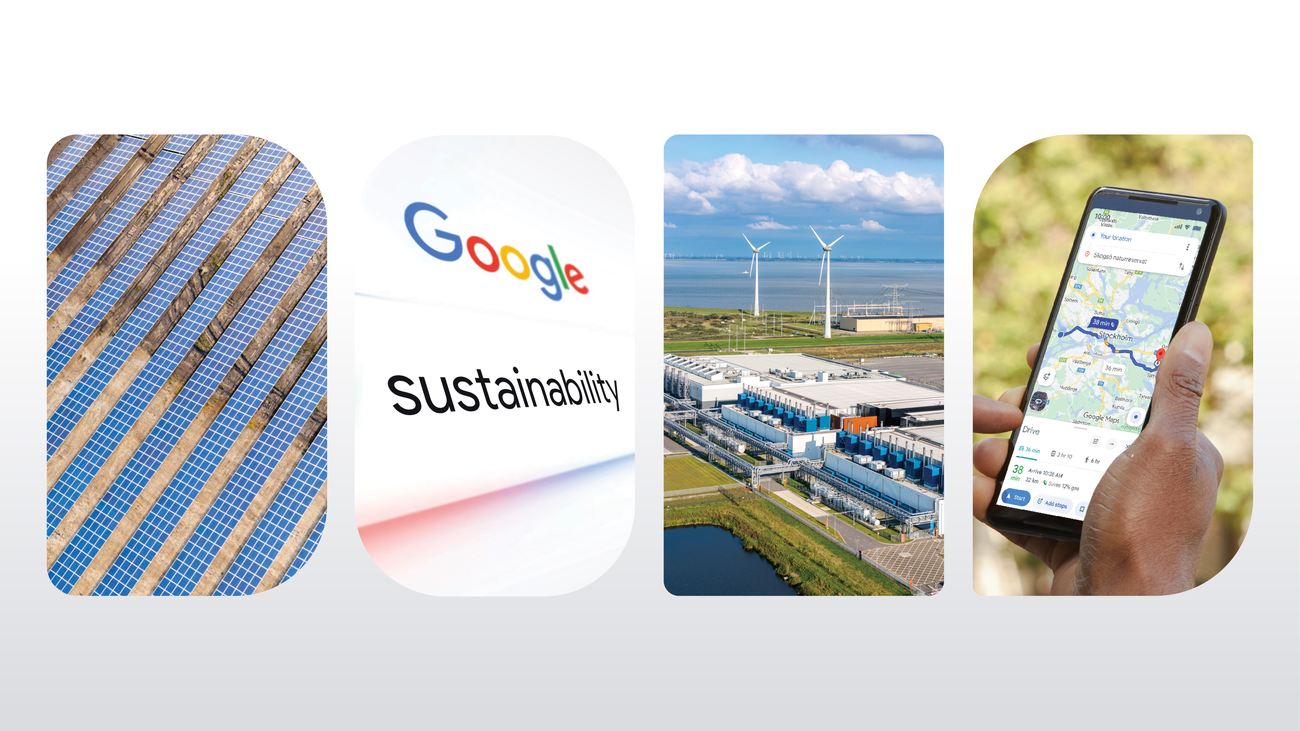
Today we publish our 11th Environmental Report, which provides a holistic view of our sustainability performance in 2025. The year’s most impressive highlights: In 2025 alone, we signed deals for over 12 GW of net new clean energy – roughly enough to power a country the size of Greece for a year once operational. At the same time, we have successfully reduced our operational emissions by 2% despite the significant continued growth in our electricity demand.
Our report navigates the tension between hyper-growth and environmental stewardship and proves our ongoing commitment to a more sustainable future. At Google, we are deeply committed to responsibly managing the environmental footprint of our operations and unleashing the power of AI for the planet. While the path to achieving our climate ambitions will not be linear – as our AI infrastructure is currently accelerating faster than the grid is decarbonising – we remain focused on scaling abundant and affordable clean power globally and advancing technology innovations that drive emissions down across our operations and the wider industry.
Delivering record clean energy while investing in future energy breakthroughs
The AI revolution has made the last five years particularly transformative, and we are proud of the progress we have made in balancing growth, innovation and environmental ambition.
Google is one of the largest corporate acquirers of clean energy in the world. From 2010 to 2025, we signed more than 240 agreements to purchase nearly 35 GW of net new clean energy. Through these cumulative agreements, we are expanding the global power supply with enough new capacity to power over 28 million American homes, or virtually all households in New York, Texas and Pennsylvania combined. When paired with our industry-leading data center infrastructure – which uses 83% less overhead energy than the industry average – we work to ensure that every megawatt is used as efficiently as possible.
Despite navigating our largest load growth in history – a 37% annual increase in electricity demand – we successfully reduced our operating emissions by 2% year-on-year while matching 100% of our electricity consumption with renewable energy purchases for the ninth year in a row. These milestones demonstrate that it is possible to decouple our rapid operational growth from our carbon footprint.
To achieve this, we invest in reliable, clean capacity on the local networks that support our data centers. We also help catalyze advanced energy sources – such as nuclear and enhanced geothermal energy – while making long-term investments in breakthrough technologies such as fusion. We are committed to being a good neighbor, which starts with ensuring our expansion does not burden local communities or other utility customers. We deliberately structure our energy contracts to cover 100% of the cost of the power we use. Our responsible growth strategy also focuses on expanding access to affordable, reliable and clean energy for everyone in the communities where we operate.
In addition, advances in machine hardware efficiency, software and computing efficiency, and clean energy procurement combined avoided over 58 million tonnes of carbon dioxide equivalent (tCO2e) in 2025 alone. Without these interventions, we estimate that our ambitious 2025 carbon footprint would have been five times larger. The magnitude of our avoided emissions proves that our decarbonization tools are working, even as we grow at hyperscale.
Our pursuit of efficiency extends beyond energy to the rest of our operations and value chain. By 2025, our water management projects replenished approximately 7.7 billion gallons of water—about 78% of our 2025 freshwater consumption, marking progress toward our ambition to replenish more water than we consume by 2030.
Advancing solutions for the planet through AI products and research
Our impact goes beyond just making Google more sustainable. It’s also about using our technology to create a better future for everyone. Our data centers power AI products that are used by billions of people around the world to drive progress across science, health, economics and more.
We see – and are actively seizing – a huge opportunity for AI to help drive progress on environmental issues specifically. By 2025, nine of our solutions enabled individuals, cities and partners to collectively reduce an estimated 41 million tCO2e. This is approximately three times Google’s own emissions. For example, we help others reduce emissions through efficiency gains in high-impact sectors such as energy and transport. Examples include: Google Earth, which optimizes layouts for solar and wind developers to speed project placement; Nest thermostats, which use machine learning to automate energy savings in the home; and fuel-efficient route in Google Maps, which analyzes factors such as traffic and terrain to suggest lower-emission routes for drivers.
We also support local communities to stay safe during extreme events and natural disasters. Building on our long-standing efforts to provide timely information to help protect people in harm’s way, we have advanced AI breakthroughs that enable forecasting and early detection of natural disasters such as wildfires, floods, earthquakes and extreme weather.
And we’re working to protect the planet through powerful AI tools—like Perch, a bioacoustic nesting model for analyzing massive bioacoustic data sets, or SpeciesNet, an Earth AI model that can recognize over 2,000 animal species in motion-triggered wildlife camera images with over 94% accuracy—making conservation more accessible, more effective and affordable.
Ultimately, as we develop new AI solutions to address global challenges, our task is to maximize the enormous good AI can do for the planet while minimizing its resource intensity.
Progress towards our climate and energy moonshot requires significant innovation
At the start of the decade, we launched net-zero and 24/7 carbon-free energy moonshots designed to push the boundaries of what’s possible in energy systems and data center operations. From the start, we were clear that these moonshots were deliberately aspirational and that success would require significant innovation in technology and policy. Over the past few years, the rapid advancement of artificial intelligence has reshaped the global infrastructure and placed new demands on the web. Our moonshot pushed us to meet this moment, and the scale of our impact has grown accordingly. In 2025, we contracted for eight times more clean energy than we did in 2019, and the emissions we successfully avoided in 2025 were seven times greater than our 2019 aspirational carbon footprint, our moonshot baseline.
Although we remain deeply committed to sustainability, it is becoming more difficult to reach our climate moonshot. It takes energy and resources to support the growing demand for artificial intelligence that powers businesses and the tools we use every day. Like everyone in our industry, we experienced an increase in demand for electricity last year. Our build-out of AI infrastructure is accelerating faster than the grid is decarbonizing, and long wait times to connect to the grid, fragmented markets, supply chain delays and regulatory bottlenecks continue to slow new carbon-free energy from coming online. We work within energy systems that are simply not clean enough or flexible enough yet.
Although we were successful in reducing our operational emissions, our supply chain emissions grew by 25% year-on-year. This increase reflects not only the scale of new AI infrastructure, but also an Asia-Pacific supply chain that operates on grids that remain undersupplied with carbon-free energy. This is partly due to land constraints, high construction costs and political and regulatory obstacles.
Looking ahead
We continue to evolve our approach in step with the technology we build, and we regularly assess our strategy as we move forward with stable execution, balancing our bold climate ambition with the real world. We will continue to prioritize AI stack efficiency, clean energy and innovation to ensure our efforts harness AI’s transformative potential to improve lives globally.