

AI has the potential to help solve some of the world’s biggest challenges – not only in the digital world, but also in the physical world. Robotics is one of the most exciting frontiers of artificial intelligence, where advances in language, vision, and action models can help create intelligent machines that interact with the real world in safer, more helpful, and more adaptive ways.
That’s why we’re launching the Google DeepMind Accelerator: Robotics, a three-month program for early-stage robotics startups across Europe. This week, the selected startup founders gather to kick off the program, meet the Google DeepMind and Google teams, and begin a journey designed to support the next generation of physical AI. They get access to our AI stack, technical expertise and Gemini robot models.
Selected from a strong pool of applicants, these startups will receive hands-on support from Google DeepMind and Google experts throughout the program. Through technical mentorship, product guidance and a broad network of partners, the accelerator will help founders transform cutting-edge AI research into real-world robotics applications. The cohort joining us in London this week reflects the breadth of opportunities in embedded AI – from logistics and manufacturing to healthcare, climate and advanced navigation.
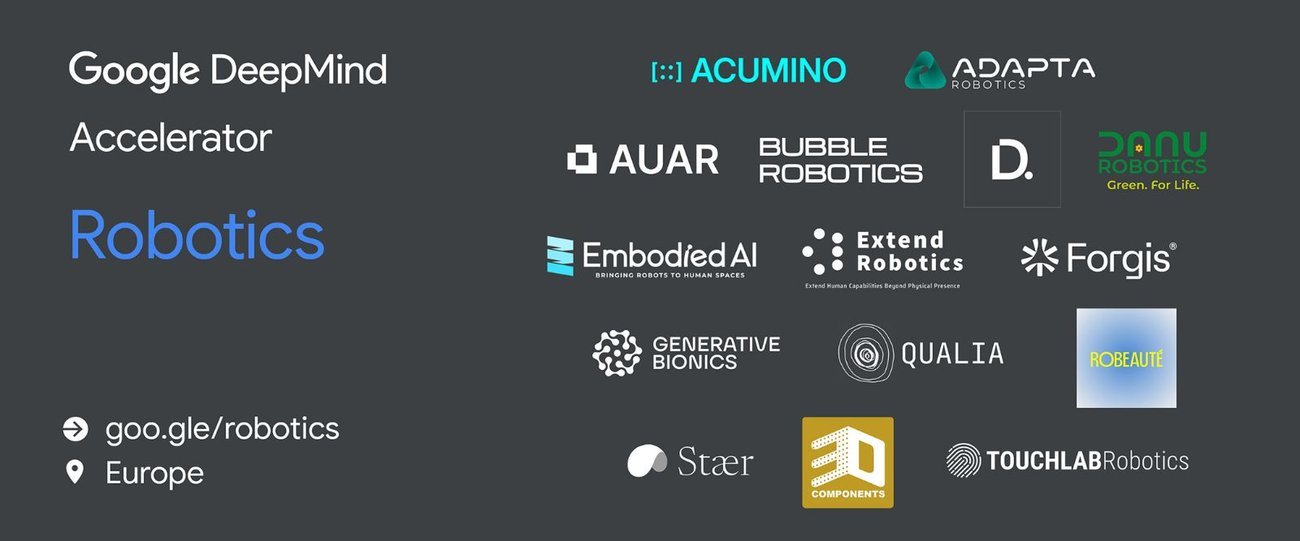
Meet the startups and founders shaping the future of robotics and embodied AI:
- 3D-Components AS (Norway): Development of RobTrack, an AI-powered platform that automates parameter selection and quality control for robotic welding and metal 3D printing, 280X faster than current practice.
- Acumino (Greece): Develops hardware-agnostic physical AI that enables robots to perform complex industrial tasks in a scalable, cost-effective and reliable manner with high ROI.
- Adapta Robotics (Romania): Deploying physical AI that replicates human touch to test devices and software for healthcare, automotive and consumer electronics, unlocking automated QA and supporting the circular economy.
- AUAR (automated architecture) (Great Britain): Making home construction more affordable by deploying robotic MicroFactories directly on construction sites.
- Bubble Robotics (France): Building the ocean’s autonomous workforce: a vesselless constellation of self-docking surface and subsea robots that see, hear and act and feed a living underwater world model.
- Danu Robotics (Great Britain): Uses embedded AI robotic systems to automate complex waste sorting, increase efficiency, improve safety and enable scalable recovery of valuable materials supporting the circular economy.
- Delta GmbH (Germany): Digitizes production line work, transforming workflows into process graphs that help teams optimize manual processes and automate repetitive tasks so people can focus where they matter most.
- Embodied AI (Switzerland): Installs teleoperated humanoids that collect data during customer service to continuously train and improve their manipulation skills.
- Expand Robotics (Great Britain): Provides teleoperation software and data pipelines that help train and fine-tune foundation models for real-world robotic applications.
- Forgive (Switzerland): Develops AI agents that understand machines like experienced engineers, predict errors and optimize operations.
- Generative Bionics (Italy): Enhancing human potential by developing humanoid robots based on physical AI, developed in Europe but built to scale globally.
- Qualia (Denmark): Building infrastructure that enables companies to transform robotic foundation models into working implementations, automating and optimizing time-consuming manual work.
- ROBEAUTE (France): Building microrobots that navigate through brain tissue to diagnose, treat and monitor neuropathology, establishing a new physical infrastructure layer in neurosurgery.
- stands (Sweden): Uses computer vision on existing cameras and sensors to build 3D spatial models of facilities, giving robots a common environment to navigate and operators real-time visibility into how their physical operations are actually running.
- Touchlab (Great Britain): Uses advanced nano-ink to create an “e-skin” that gives robots a high-resolution sense of touch across flexible surfaces.
These startups reflect the growing momentum of robotics and intelligent systems across Europe. Each company will receive mentorship and strategic guidance from Google DeepMind and Google to help them accelerate development and scale responsibly.
Congratulations to this year! To learn more about Google DeepMind Accelerator: Robotics, visit the official program page.