
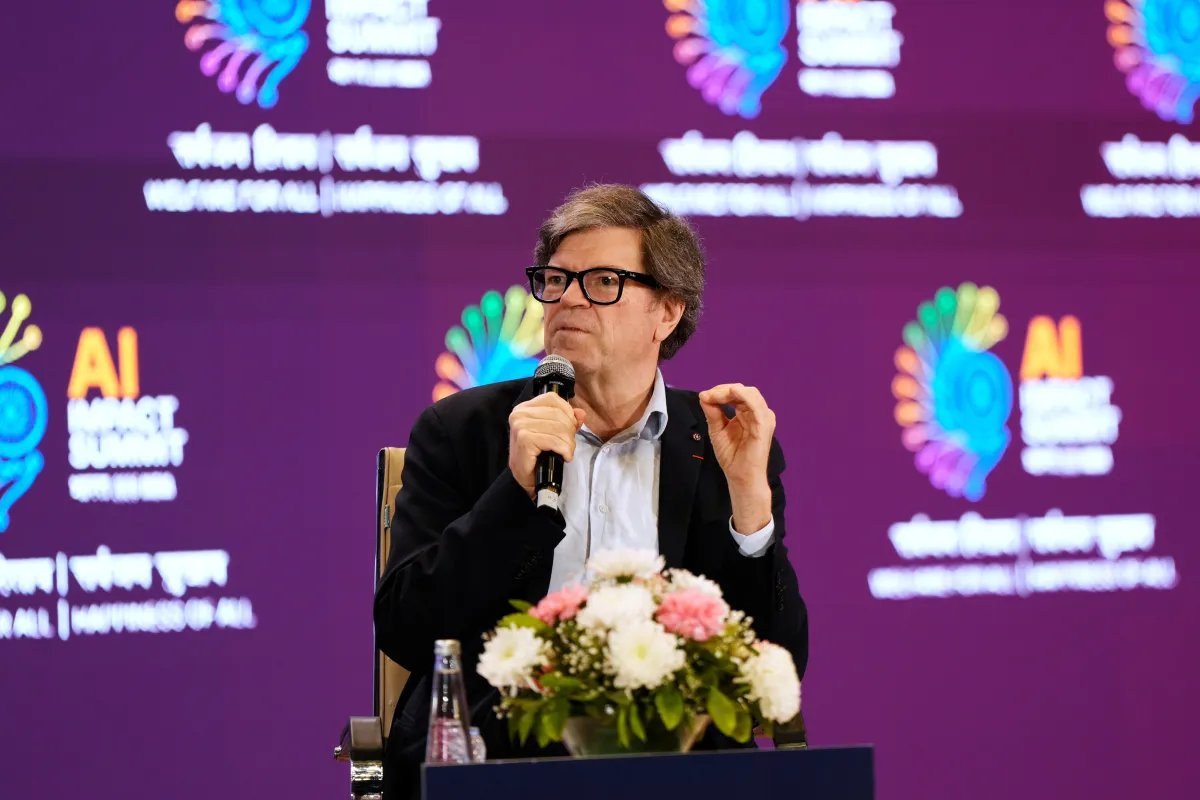
AMI Labs, the new venture founded by Turing Award winner Yann LeCun after he left Meta, has raised $1.03 billion at a pre-money valuation of $3.5 billion. AMI works on world models, or AI that learns from reality, not just from language.
This category has fewer players than generative AI, but maybe not for as long. “My prediction is that ‘world models’ will be the next buzzword,” AMI Labs CEO Alexandre LeBrun told TechCrunch. “In six months, every company will call itself a world model for raising funding.”
LeBrun said this with a smile because he believes AMI Labs is fundamentally different: its goal is to understand the real world. This could have applications in healthcare, with AMI Labs’ first partner being Nabla, the digital healthcare startup of which he is now chairman.
As CEO of Nabla, LeBrun had reached the same conclusion as LeCun about the limitations of large language models (LLMs), where hallucinations could have life-threatening consequences. But he also knows it will take a while for the startup to offer a viable alternative based on JEPA, the Joint Embedding Predictive Architecture proposed by LeCun in 2022.
“AMI Labs is a very ambitious project because it starts with basic research. It’s not your typical applied AI startup that can release a product in three months, have revenue in six months and make $10 million in [annual recurring revenue] in 12 months,” LeBrun said. In contrast, world models can take years to move from theory to commercial applications.
Despite this time horizon, companies developing world models have attracted large checks. SpItial raised a seed round of $13 million – unusually large for a European startup; while Fei-Fei Li’s World Labs secured a whopping $1 billion last month alone. Now AMI Labs is joining the club with more funds than originally rumored.
The French AI lab reportedly sought just €500 million last December, but ended up raising around €890 million, likely thanks to its team. In addition to LeCun’s commitment as chairman and LeBrun’s track record as an entrepreneur, it also boasts Meta’s VP of Europe Laurent Solly as COO, and high-profile researchers Saining Xie as chief science officer, Pascale Fung as chief research & innovation officer and Michael Rabbat as VP of world models.
Techcrunch event
San Francisco, CA
|
13.-15. October 2026
According to LeBrun, great interest gave the startup a chance to choose its investors, both in terms of matching expectations and background. The round was co-led by Cathay Innovation, Greycroft, Hiro Capital, HV Capital and Bezos Expeditions, with participation from several other foundations and industry-connected supporters, as well as individuals, including Tim and Rosemary Berners-Lee, Jim Breyer, Mark Cuban, Mark Leslie, Xavier Niel and Eric Schmidt.
Value-added aside, this funding will provide AMI Labs with a meaningful trajectory to divest its two main cost centers: computing and talent. LeBrun said he will prioritize quality over quantity to build AMI Labs’ team in four key locations: Paris, where it is headquartered; New York, where LeCun teaches at NYU; in Montreal, where its Rabbat is based; and in Singapore, both to recruit AI talent and to be close to future customers in Asia.
While AMI Labs has no plans to generate revenue at this time, they still plan to engage with potential customers early on. “We develop world models that seek to understand the world, and you can’t do that locked in a lab. At some point, we have to put the model into the real world with real data and real evaluations,” LeBrun said.
When the time comes, AMI Labs will be reaching out to partners to explore implementations — and Nabla is the first revealed partner that expects to get access to these early models, but certainly not the last. “This may explain the presence and strong interest of certain industrial players and potential partners in the investment round,” LeBrun said.
In addition to its lead investors and angels, AMI Labs is backed by NVIDIA, Samsung, Sea, Temasek and Toyota Ventures, as well as French players Association Familiale Mulliez, Groupe Industriel Marcel Dassault and Publicis Groupe. Aglaé Lab, Alpha Intelligence Capital, Artémis, Bpifrance Digital Venture, New Legacy Ventures, SBVA and ZEBOX Ventures also participated.
These investments may take some time to turn into commercial applications. But staying true to LeCun’s beliefs, AMI Labs will publish papers as it goes.
“We also want to open source a lot of code,” said LeBrun, who had also worked at Meta’s AI research lab, FAIR. While open research is “increasingly rare,” the founders of this startup still believe in it. “We think things move faster when they’re open, and it’s in our best interest to build a community and a research ecosystem around us.”